


Among Us, the multiplayer social deduction game created by Innersloth in 2018, became a global phenomenon when it went viral in 2020. The premise is deceptively simple: a crew of characters aboard a spaceship must complete tasks to keep systems running, while one or more secret enemies work to eliminate them from the inside.
An impostor in Among Us is a secret enemy whose main goal is to eliminate the crewmates. Impostors can be one to three per game, meaning you might face a solo killer or coordinate with other impostors in multi-impostor lobbies. They win by reducing crewmates to parity – where impostors equal the number of remaining crew – or by triggering an unresolved sabotage like a reactor meltdown.
Learning how to read telltale signs, how to perform under pressure as either role, and how to enjoy the social deduction layer with friends or strangers is what separates a forgettable round from an amazing one. This guide covers everything you need to identify, play, and survive the imposter among us.
Telltale Signs Of An Impostor During A Match
No single clue confirms someone is the impostor. Good players in Among Us avoid relying on a single clue to identify the impostor. Instead, they stack observations into evidence strong enough to justify a vote. Here are the behavioral signals that raise suspicion:
- Avoiding groups. Impostors often avoid large groups to commit murders. If someone consistently drifts away from teammates when others cluster, watch them carefully.
- Wandering without purpose. Players wandering off alone are often impostors. A crewmate with real tasks moves between specific rooms. An impostor may loop corridors, pause at random panels, or stand in empty rooms waiting for an opportunity.
- Random pausing near walls. This often means a player is opening the sabotage map. It looks different from the purposeful stop at a task panel.
- Proximity to victims. The person nearest a body is usually the killer. If someone is consistently “last seen with” a player who turns up dead, that pattern demands a discussion.
- Map-specific giveaways. On The Skeld, an impostor might hover near Electrical – a common kill spot – without ever completing the wiring task. On Polus, suspect anyone who lingers near Specimen Room without a clear objective.
Dead Body Reports And Emergency Meetings
When a player discovers a dead body, they can report it to trigger a meeting. Alternatively, any player can call an emergency meeting from the cafeteria button. Both pause the game and open the floor for discussion, but the context behind each matters.
Impostors can self-report bodies to deflect suspicion. By “finding” their own kill, they control the narrative – framing another player, establishing a false alibi, or simply resetting the round’s rhythm. According to Among Us VR beta data from Innersloth, approximately 75% of crewmate wins came through successful ejections, which means meetings are where games are won or lost.
When someone hits that report button, question them logically:
- Where exactly was the body reported?
- Which direction did the reporter come from?
- Who did they cross paths with on the way?
- Does the timing match where they claimed to be?
Watch for suspicious patterns: one person reporting many bodies across rounds, inconsistent stories when two players compare notes, or attempts to rush a vote before the discussion finishes. Crewmates need to communicate and cooperate during meetings to vote out the impostor – silence helps no one except the killer.
Reading Movement And Task Behavior
Movement and task behavior are the most reliable in-game analytics for spotting impostors. A legitimate crewmate moves with purpose – heading to a task location, pausing an appropriate amount of time at the panel, then moving to the next one. Their path follows the task list.
Impostors should pretend to complete tasks to avoid suspicion, but faking convincingly is harder than it looks. Common mistakes include standing at a panel for too short or too long, choosing a location with no active task in that lobby’s configuration, or leaving a room abruptly the moment another player enters.
Visual tasks have visible animations that players can observe to confirm task completion. A MedBay scan or garbage eject on The Skeld produces an on-screen animation that cannot be faked. If visual tasks are enabled, asking a suspect to perform one is strong evidence.
Players should monitor task bar progress to identify suspicious behavior. When taskbar updates are set to “always,” you can watch for the bar to move when someone claims to finish a task. On modern settings where the taskbar only updates during meetings, you must rely on long-term pattern recognition – tracking who claims what over multiple rounds and whether the overall progress matches expectations.
Vent Usage, Vision, And Map Awareness
Vents are a signature impostor mechanic in the original game. Impostors can vent for quick movement across the map, popping into one vent and emerging from another connected vent seconds later. No crewmate has this ability, so venting in view of another crewmate reveals an impostor immediately – it is the most obvious and conclusive piece of evidence in the game.
On The Skeld, the MedBay–Security–Electrical vent triangle is notorious. An impostor can kill in Electrical, vent to MedBay, and pretend to have been scanning. If you see someone in MedBay who wasn’t there moments ago, and a body later turns up in Electrical, cross-check their claimed route.
Vision settings also matter. With crewmate vision at 0.75x and impostor vision at 1.5x, an impostor can see threats approaching from much farther away. If someone claims “I didn’t see anyone in that corridor,” consider whether their vision radius would realistically allow that claim.
Use map knowledge to cross-check alibis during meetings. Can a player plausibly travel from Reactor to Weapons in the time they claim without using a vent? If the answer is no, you have your suspect.

Social Tells: Chat, Voice, And Psychological Cues
Among Us is as much a social deduction game as a mechanical one. What players say – and how they say it – reveals a bit about their role.
Research from the AmongAgents study analyzing LLM-controlled players found that impostors tend to use more defensive speech: vague denials, deflections, and excessive explanations rather than direct statements. These patterns show up in human play too.
Watch for these cues during a discussion:
- Over-defending a partner. If one player aggressively clears another without solid evidence, they may be protecting a fellow impostor.
- Changing stories under pressure. A crewmate with a real alibi rarely contradicts themselves. An impostor improvising may get details wrong.
- Staying silent during critical votes. Silence can be strategic – letting others do the arguing while avoiding scrutiny.
- Immediate counter-accusations. If you casually mention someone’s name and they explode into defense, that reaction itself becomes a data point.
To identify an impostor, players must combine observations and evidence during discussions. Build the habit of mentally noting who defends whom, who leads every vote, and who conveniently “forgets” key details round after round.
How To Play As The Impostor (And Not Get Caught)
Playing the impostor well requires equal parts planning and composure. Your win condition is clear: kill enough crewmates so that impostors equal the surviving crew, or pull off a critical sabotage that nobody fixes in time.
Here is a practical strategy framework:
- Learn the maps. Memorize task clusters, vent networks, and camera locations. On The Skeld, Security cameras cover key corridors. On Polus, the vitals screen can reveal kills instantly.
- Fake tasks convincingly. Match expected task durations. Don’t claim visual tasks unless you can talk your way out of not having an animation. Stand at believable panels.
- Pace your kills. Impostors can kill players using various methods, but spacing kills by time prevents obvious patterns. Wait for cooldowns to reset naturally rather than hunting aggressively.
- Use sabotage proactively. Impostors can sabotage systems to create chaos – lights, comms, reactor, oxygen. Sabotages change gameplay by creating urgent situations that reveal player behavior. Impostors can create emergencies to force crewmates to respond, creating opportunities for attacks in isolated areas.
- Talk, but don’t overdo it. Speak enough to seem helpful. Never panic-defend a partner so strongly that you both get ejected. Let others lead votes when you can.
The best impostors are the ones nobody suspects until it’s too late.
Alternative Roles And Other Impostors Variants
Post-2021 updates and popular mods introduced new flavors of other impostors, changing how suspicion and detection work.
The most significant official variant is the Shapeshifter, an impostor who can temporarily copy the appearance of a living crewmate. This complicates color-based accusations – “I saw Red do it” means less when Red’s skin could have been borrowed.
Community mods go further, introducing archetypes like Phantoms that turn invisible, or roles that dissolve bodies over time. These aren’t part of the official game but happen frequently in modded lobbies and streaming content.
Hide ‘n Seek mode flips the formula entirely. The impostor, called the Seeker, is revealed from the start. Strategy shifts from social deduction to pure survival routing. No meetings, no votes – just running and hiding.
Whether playing the original game or experimenting with variants, watching patch notes and understanding lobby rules before each match saves you from making wrong assumptions.
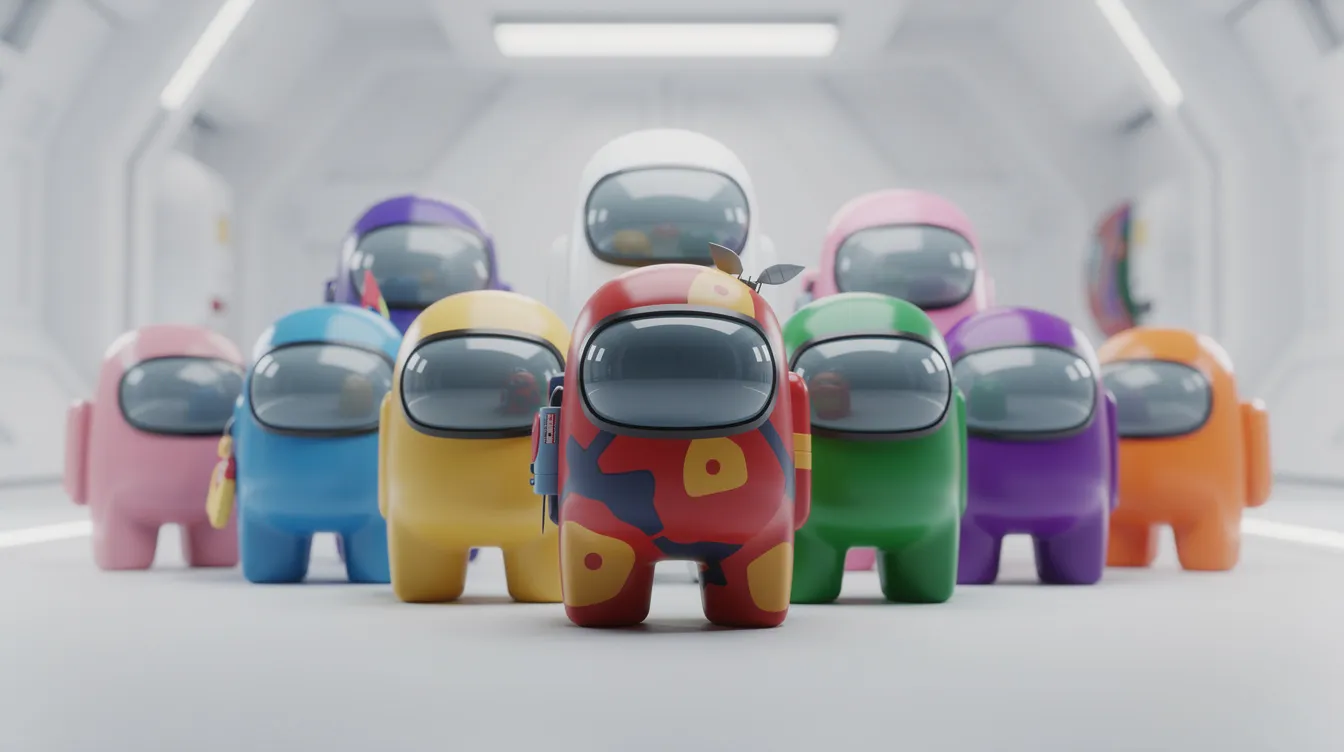
Memes, Culture, And The Lasting Appeal Of Among Us
Among Us didn’t just become a game – it became a cultural scene. When it exploded in mid-2020 through Twitch and YouTube, the word “sus” entered mainstream language so thoroughly that Merriam-Webster added it as recognized slang. Derivatives like “sussy baka” and the abstract “Amogus” meme saturated every platform from Reddit to TikTok.
The impostor silhouette became instantly recognizable – people started posting comments about real-world objects resembling crewmate shapes. Fan art, animations, and crossover appearances in other games cemented the characters in entertainment beyond the original screen.
This culture feeds back into gameplay. Lobbies are full of playful accusations, meme references, and inside jokes. The community keeps the game alive years after its January 2020 surge, proving that social deduction with the right group never gets old.
Practical Tips To Improve And Enjoy Your Games
This section condenses the guide into actionable habits you can use starting tonight.
For crewmates:
- Always know your next task before you leave a room. Aimless wandering makes you look suspicious and wastes time.
- Glance at the map between rooms and mentally track “last seen with” for every player. When a body is reported, this knowledge wins votes.
- Share your observations early in meetings. Staying quiet helps enemies, not your team.
For impostors:
- Plan your kill route before the round starts. Know where you’ll strike, which vent you’ll use, and where you’ll pretend to be afterward.
- Use sabotage to break up groups, not just as a distraction. Reactor and oxygen force two players to opposite ends of the map – exploit that.
- Vary your behavior. If you always kill in Electrical, experienced players will catch the pattern after one game.
For everyone:
- Play with a regular group of friends via Discord. Organized groups with voice chat produce richer discussion, fewer trolls, and more satisfying rounds. Data suggests crewmate win rates jump to roughly 70% with coordinated communication versus public lobbies.
Every match is practice. You’ll get ejected on wrong evidence. You’ll attempt a bold kill and get caught at the worst moment. You’ll be called sus when you’re completely innocent. That’s the game. Embrace it, experiment with different strategies, and keep sharpening your ability to read – or deceive – the people around you. Whether you stand as a loyal crewmate or hide as the imposter among us, every round teaches you something new.


